
Fire stopping gets covered up fast. A seal that goes in on Monday can be behind a board by Friday. From then on, the only proof it was done right is the record made at the time.
That is why a fire stopping inspection matters, and why the paperwork from it matters as much as the seal.
What is a fire stopping inspection?
It is a check that each fire stop is the right product, in the right place, installed the way it was tested, and labelled. The ASFP counts penetration seals, linear joint seals and cavity barriers as fire stopping, so all three are included.
The ASFP’s code of practice also says the inspector should go by the manufacturer’s instructions, not by what the installer tells them, and should not direct the installation.
How much should be inspected, and when?
The ASFP sets this out in TGD 17, its code of practice for installing and inspecting fire stopping. It is guidance, not law. This is the pattern it suggests:
| When | Who | How much |
|---|---|---|
| During installation | The installing contractor | All of it |
| At handover | The client’s representative | At least 20% of each type, spread through the building. This can drop to around 5 to 10% if the installer is third-party certificated |
| After other trades have worked nearby | The building manager or responsible person | All of the areas affected |
| Every year | The responsible person or a competent person | All areas next to or forming escape routes |
If the inspection finds significant defects, it carries on until the rest can be judged satisfactory.
The handover figure is worth knowing if you are thinking about FIRAS or IFC certification. A smaller sample at handover is time saved on every job.
What gets checked on each seal
Appendix B of TGD 17 is the inspection and handover checklist. In plain terms, it asks:
- Is it the correct type of fire stopping?
- Is it identified and labelled?
- Is it in the right place, checked against the drawings?
- Were the supports fitted with approved fittings?
- Is there clear access to it for maintenance?
- Has the space around it been kept clear of other services?
- Was it complete and labelled at handover, and recorded on the handover register?
The inspector also checks critical thicknesses and dimensions against the specification, and looks for air gaps between the service and the seal.
What goes on the label
TGD 17 suggests a label or plate on the seal, or next to it, showing the seal number, the fire resistance period, the installer and the operative’s name, the date it went in, and how often it should be inspected.
The seal number is what links the seal on the wall to its line in the register.
Why the record matters
TGD 17 makes a simple point. Fire stopping is often hard to get at later, so it has to be inspected before handover.
Regulation 38 of the Building Regulations requires fire safety information to be passed to the responsible person at the end of the job. The changes to Approved Document B that came into force on 2 March 2025 focused on that duty.
On higher-risk buildings, the developer has to give the Building Safety Regulator as-built drawings and fire safety documentation to get a completion certificate at Gateway 3. Law firm Cripps lists missing installation evidence and missing fire stopping sign-offs among the reasons those applications are delayed.
If you installed the seals, that request comes back to you.
Making it easier on your own jobs
Photograph each seal before it is covered, and again when it is finished. Number it and pin it to the drawing on the day, not at the end of the week.
Use the same form for every seal, so the inspector sees the same information each time. When a fault is found, record the fix against the same seal, so the record shows it was put right.

Where FireArrest fits
We built FireArrest with firestopping professionals to do exactly this.
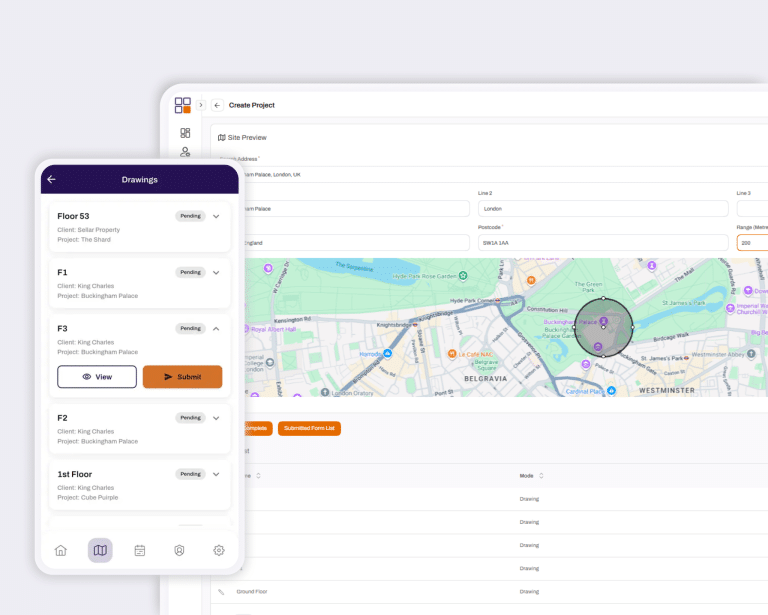
Your team pins each seal to the drawing on site, with date and time-stamped photos, and fills in your own forms on the device, even with no signal. Geofencing shows they were on site when the work was logged. The audit trail cannot be edited, so it shows who did what, and when.
When the main contractor or your auditor asks for the evidence, you send a branded report built from your own template. Repeat inspections can be set up as recurring tasks.

You can see how it works on our firestopping software page. If you would like to try it on your own jobs, the free trial runs for 10 working days. We set it up with you on a short call, and we do not ask for card details. If you would rather talk it through first, book a 30-minute demo.
Common questions
How often should fire stopping be inspected?
All of it during installation, a sample at handover, all of any area where other work has been done since, and every year in areas next to or forming escape routes. After handover, inspections should be part of the building’s maintenance plan.
Who can inspect fire stopping?
The installer checks their own work as it goes in. The client’s representative carries out the final inspection. Where an independent inspection is needed, for example on a safety-critical project, a third-party inspector can be used.
Does fire stopping have to be installed by a third-party certificated contractor?
No, it is not a legal requirement. The ASFP recommends that fire stopping is installed by third-party certificated contractors, through schemes such as FIRAS and IFC Certification.
What should be handed over at the end of a fire stopping job?
TGD 17 lists the designer’s drawings showing the compartment walls and where the fire stopping is, cross-referenced to a schedule of every fire stop with its rating and location. Add the maintenance requirements, the installation checklist, the inspection and handover checklist, and the handover register.