A familiar building can feel very different when the fire alarm sounds. Visitors may not know which staircase to use, staff may need an alternative to their usual entrance, and anyone raising the alarm needs to find the nearest call point quickly.
That is where fire signage earns its place. Clear, well-positioned fire signs help people find their way out, locate fire safety equipment and understand the instructions that matter. They work alongside alarms, emergency lighting and fire doors, rather than replacing them.
For building managers, auditors and fire protection teams, the challenge is not simply to put up enough fire action signs. It is to make sure the right information appears where people need it, without creating a wall of competing messages. The Health and Safety Executive’s guidance on safety signs makes this point: signs should be clear and legible, while too many can cause confusion.
This guide focuses on England and Wales, where the Regulatory Reform (Fire Safety) Order 2005 applies. It also explains the England-only requirements for certain residential buildings and provides general information, not a building-specific compliance assessment. The legislation, fire risk assessment and fire safety arrangements will help guide your decisions about your premises.
What is fire signage?
Fire signage brings together the signs and notices that help people respond to a fire. Some show the escape route or identify an exit. Others mark fire extinguishers, explain what to do when the alarm sounds, or remind people not to compromise a fire door.
The most effective arrangement makes sense to someone who has never visited the building before. People should not have to guess which way an arrow points, search behind furniture for a sign or read several notices to work out the next step.
In workplaces, the Health and Safety (Safety Signs and Signals) Regulations 1996 form part of the legal framework. Employers must provide suitable signs where significant risks remain after other relevant controls. Signs support those controls; they are not a substitute for removing a hazard or making an escape route safe.
These regulations apply in Great Britain. Northern Ireland has its own Health and Safety (Safety Signs and Signals) Regulations (Northern Ireland) 1996.
What does the law require?
In England and Wales, the Fire Safety Order places duties on the responsible person for relevant premises. Depending on who controls the building, that may be an employer, owner, landlord or managing agent. Where several organisations share responsibility, they need to co-operate.
The GOV.UK guide to workplace fire safety responsibilities explains the wider duties, including assessing fire risks, maintaining precautions, planning for emergencies and providing staff with information and training. Signage belongs within those arrangements, rather than sitting apart as a one-off installation job.
Escape routes, exits and maintenance
Article 14 of the Fire Safety Order requires emergency routes and exits to have signs where necessary to safeguard people. It also addresses keeping escape routes clear, providing suitable exits and ensuring emergency doors are easy to open immediately when needed.
The same article requires adequate emergency lighting on escape routes that need illumination if their normal lighting fails. A sign pointing towards an exit cannot make up for an obstructed route or inadequate lighting.
Once signs are in place, they need looking after. Article 17 requires a suitable maintenance system for relevant fire safety provisions where necessary to safeguard people. The safety signs regulations also require regular cleaning, checking, repair and replacement as appropriate.
A faded sign, missing arrow or notice hidden by new shelving should therefore prompt action, not wait until the next refurbishment.
What about Scotland and Northern Ireland?
The Fire Safety Order does not apply throughout the UK. Scotland’s framework includes the Fire (Scotland) Act 2005 and the Fire Safety (Scotland) Regulations 2006. Northern Ireland’s framework includes the Fire and Rescue Services (Northern Ireland) Order 2006 and the Fire Safety Regulations (Northern Ireland) 2010.
The practical aim remains clear communication and safe escape, but dutyholders should use the legislation and guidance relevant to the building’s location.
Understanding fire safety sign colours and shapes
Safety signs use recognisable combinations of colour, shape and symbols so people can understand their purpose quickly.
Green signs identify emergency escape routes and exits, as well as first-aid facilities. Red signs identify fire-fighting equipment, but red also appears in prohibition signs such as “No smoking”. Shape helps distinguish those messages – an equipment sign is normally square or rectangular, while a prohibition sign uses a red circle and diagonal bar.
Yellow or amber triangular signs warn of hazards. Blue circular signs tell people that a particular action is mandatory.
| Colour | Meaning | Usual shape | Typical fire safety use |
|---|---|---|---|
| Green | Emergency escape and first-aid signs | Square or rectangle | Fire exit signs, escape route arrows, assembly points |
| Red | Prohibition, danger alarm and fire-fighting equipment | Circle with a slash for prohibition signs, square or rectangle for equipment | Fire extinguisher signs, alarm call point signs and “no smoking” signs |
| Yellow or amber | Warning | Triangle | A fire warning sign for a specific hazard |
| Blue | Mandatory action | Circle | Instructions that must be followed |
These conventions help people recognise the message, but colour alone is not enough. The symbol, wording, size and position all contribute to whether someone can understand a sign in the event of a fire.
The main types of fire signage
Helping people find the exit
Fire exit signs should make the escape route easy to follow, particularly where people face a choice of direction. A corridor junction, staircase entrance or unfamiliar doorway is exactly where uncertainty can slow someone down.
Rather than treating each sign as an isolated item, look at the route as a whole. Can someone identify where to go next? Does the arrow match the route? Will an open door obscure the sign?
The arrangement should suit the building and its assessed risks. Some exit doors also need operating instructions, such as “Push bar to open”, so people can use the exit without hesitation.
Identifying fire equipment and alarm call points
Equipment signs help people locate extinguishers, hose reels and manual alarm call points. Under the safety signs regulations, the location and identification of fire-fighting equipment must have permanent marking through signboards, a safety colour or both, with red used to identify the equipment.
Signs for fire extinguishers can also provide useful information about the equipment but they should support suitable selection, instructions and training rather than encourage someone to tackle a fire beyond their capability.
For more on the wider duties, read our guide to fire extinguisher regulations in the UK.
Giving clear instructions
Fire action notices explain what people should do if they discover a fire or hear the alarm. They often appear near manual call points or fire assembly points and in other prominent locations, with information such as how to raise the alarm and where to assemble.
The wording needs to match the building’s actual emergency plan. A generic notice is not helpful if it gives instructions that conflict with the evacuation arrangements for those premises.
Prohibition and warning signs have a different role. “No smoking” tells people what they must not do, while a flammable-material warning identifies a hazard. Use them where they serve a clear purpose, rather than adding notices simply because there is space on the wall.
Marking the assembly point
An assembly point sign identifies the designated gathering place outside, where the emergency plan provides for one.
The sign location needs to suit the site and its evacuation arrangements. It should allow people to move away from danger towards fire exits without obstructing escape routes or access for the fire and rescue service.
Make sure staff know where to go through induction, training and drills. A sign is useful confirmation, but people should not first learn the assembly arrangements during an emergency.
Fire door signs: the instruction needs to match the door
The UK Government regulations ‘Building regulations in England covering fire safety matters within and around buildings' through their ‘Fire Safety: Approved Document B’ provide several references, including:
- Fire door signs support an important part of the building’s fire protection, but the wording must suit how the door operates.
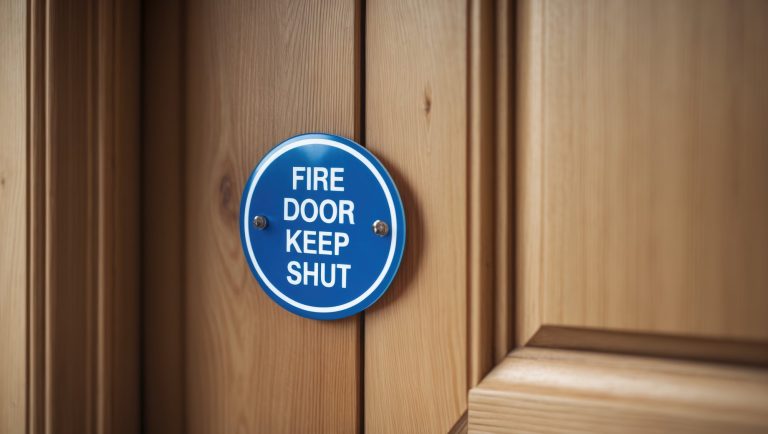
- The words “Fire door keep shut” apply where people need to leave the door closed. The words “Fire door keep locked” may be more appropriate for certain doors that normally remain locked shut, such as some service-cupboard doors. Doors with suitable automatic hold-open arrangements need the appropriate instruction to keep the closing path clear.
- The distinction matters. A door designed to close when the alarm operates needs space to move, while a door that should remain shut must not become an unofficial ventilation route.
- A fire door sign alone does not establish that a door works properly. Checks still need to identify damage, obstruction and closing problems.
Additional residential duties in England
The Fire Safety (England) Regulations 2022 introduce specific duties for residential buildings in England. They do not apply in Wales, Scotland or Northern Ireland.
In buildings containing two or more sets of domestic premises with common parts, responsible persons must give residents information about the importance of fire doors. That includes keeping them closed, not tampering with doors or self-closing devices and reporting faults or damage. Residents should receive this information when they move in and at least annually afterwards.
For multi-occupied residential buildings where the top storey is higher than 11 metres from the ground, responsible persons must also check common-part fire doors at least every three months and use their best endeavours to check flat entrance doors leading onto common parts at least annually. These checks also include self-closing devices.
The government’s information on fire doors under Regulation 10 explains these duties. They are maintenance and resident-information requirements, not a rule that every residential fire door needs the same sign.
Wayfinding signs in high-rise residential buildings
Not all fire-related wayfinding signs direct occupants towards an exit. Floor and flat-number signs in residential buildings also help firefighters navigate, particularly when visibility is poor.
Under the 2022 Regulations, responsible persons for high-rise residential buildings in England must provide floor and domestic-premises identification signs. For this purpose, a high-rise residential building contains two or more sets of domestic premises and is at least 18 metres high or has at least seven storeys.
The signs must be visible in low-level lighting or when illuminated by a torch. Floor identification signs belong on stairway landings and in lift lobbies, with domestic-premises identification supporting navigation to individual homes.
The government’s information on wayfinding signage explains the requirement and points to the relevant design specifications. Separate building regulations requirements can also apply to new buildings and relevant building work, so the high-rise threshold should not be treated as the only situation in which this signage may be needed.
Where should fire signage go?
The best way to assess positioning is to follow the route as a visitor would. Start somewhere unfamiliar and look for the next instruction before moving on.
Signs should sit within a suitable line of sight and remain easy to see from the direction of travel. That means considering the viewing distance, lighting and anything that might obscure them, including doors, shelving and later alterations.
Pay particular attention to junctions and changes of direction. The route should remain understandable without someone having to search for the next sign. At the same time, avoid competing notices that make the important information harder to pick out.
Lighting needs equal attention. Where a sign relies on a power supply, the safety signs regulations require a guaranteed emergency supply during a power cut unless the hazard has been eliminated.
Photoluminescent signs, which glow after exposure to suitable light, may form part of an appropriate arrangement. They are not an automatic replacement for emergency escape lighting. Their suitability depends on the conditions, including the available charging light and the building’s assessed needs.
Keeping signs useful as the building changes
Signs can become ineffective without anyone deliberately removing them. A new partition interrupts a route, a delivery blocks a notice or a redecoration leaves an arrow pointing towards a door that no longer serves as an exit.
Include signage in routine fire safety checks and review it after any changes to the layout, use or emergency arrangements. It’s important to look beyond whether a sign is physically present; check that it is legible, unobstructed and still gives the correct instruction.
Fire door checks should also consider whether the sign matches the door’s intended operation and whether the door closes as required. Finding a “Keep shut” sign on a wedged-open door is a reminder that signage and day-to-day management need to work together.
Always keep a record of defects and the action taken. Dated photographs and clear location references will make it easier to show what needed attention and confirm that someone resolved it.
Bringing signage into your compliance records
Signage belongs to the wider management of fire safety rather than being a passive fire protection system in itself. Even so, signs on fire doors and escape routes support the measures that passive fire protection teams inspect and maintain.
Keeping related information together can make any handovers and follow-up work easier. A photograph of a door, its location and the associated inspection record can provide more useful context than a separate note saying “sign missing”.
FireArrest supports passive fire protection teams with digital documentation, photographic evidence and reporting. Northamptonshire-based passive fire protection specialist Latimer Fire Protection is able to use accessible, time-stamped records to review work across multiple sites and retrieve evidence from earlier projects.
To discuss how the platform could support your team’s inspection and project records, book a FireArrest demo.
FAQs
What colours are used for fire safety signs?
Green identifies emergency escape routes and exits. Red identifies fire-fighting equipment and also appears in prohibition signs, where a red circle and diagonal bar distinguish the instruction. Yellow or amber warns of hazards and blue indicates mandatory action needed. The shape and symbol matter as well as the colour.
Do I legally need fire exit signs?
In England and Wales, Article 14 of the Fire Safety Order requires fire exit signs identifying emergency routes and exits where necessary to safeguard people.
The required arrangement depends on the premises and its risks, rather than a blanket rule that every doorway needs a fire exit sign. Scotland and Northern Ireland have separate fire safety frameworks.
What is BS EN ISO 7010?
BS EN ISO 7010 is the British adoption of the European and international standard for registered safety signs. It covers graphical symbols used for purposes including emergency escape, fire safety, warnings and mandatory actions.
Its international basis does not make it unsuitable for UK premises. The HSE’s UK guidance includes information about the standard.
Who is responsible for fire signage?
In premises covered by the Fire Safety Order in England and Wales, the responsible person must ensure suitable fire precautions, including signage where required. Depending on the circumstances, that may be an employer, owner, landlord or someone else with control of the premises.
Where responsibility is shared, the parties need to co-ordinate their arrangements. Appointing an installer does not remove the need to manage signs once they are in use.
Do glow-in-the-dark signs replace emergency lighting?
Not automatically. Photoluminescent signs and emergency escape lighting perform related but different functions.
Article 14 requires adequate emergency lighting on escape routes that need illumination if normal lighting fails. Selecting glow-in-the-dark signs does not, by itself, satisfy that requirement.