Fire extinguisher regulations in the UK are not found in a single statute. Instead, they span fire safety laws, British Standards, and official guidance. Together, these define what duty holders must provide, maintain, and record to keep fire extinguishers safe and in working order.
This guide explains the practical requirements so you can check your arrangements against what the law and insurers expect.
1. Legal Framework for Fire Extinguisher Regulations in the UK
The UK has no standalone “Fire Extinguisher Act.” Instead, obligations come from general fire safety and health and safety laws. British Standards (particularly BS5306) and official guidance support these requirements. Departing from the standard isn’t itself an offence, but courts accept following it as evidence you met your legal duty — so ignoring it makes compliance very hard to demonstrate after a fire.
The Regulatory Reform (Fire Safety) Order 2005 governs fire safety across England and Wales. It requires the responsible person to implement general fire precautions. This includes providing and maintaining portable firefighting equipment if a fire risk assessment shows it is needed. In Scotland, the Fire (Scotland) Act 2005 and Fire Safety (Scotland) Regulations 2006 impose similar duties on “Duty Holders.” Northern Ireland follows the Fire and Rescue Services (Northern Ireland) Order 2006.
These guidelines show that it is not necessarily a requirement that there is a fire extinguisher in every property and room, but, what is required is that there must be a fire risk assessment. Following that, it’s a legal requirement for the property to have the fire extinguishers that were recommended in the fire risk assessment.
Fire extinguishers are part of wider fire safety measures including detection and alarm systems, escape routes, emergency lighting, passive fire protection, and fire safety training. FireArrest helps organisations demonstrate their aligment with these rules through digital workflows and audit-ready records.
2. The Responsible Person and Fire Risk Assessments
The Fire Safety Order requires a responsible person for compliance at every premises. This person can be an employer, building owner, occupier, or managing agent—anyone who controls the premises. If control is divided, then it’s common for multiple responsible persons to share duties.
Fire risk assessments are legally required under the Fire Safety Order. The responsible person must ensure a “suitable and sufficient” assessment is done and recorded. This is mandatory where there are five or more employees or the premises are licensed. The assessment identifies potential fire hazards and consequences. It covers ignition sources, flammable materials, liquids, cooking fats, and electrical equipment. It also checks existing fire safety equipment and decides what extra control measures are needed. This includes the number and type of fire extinguishers required.
Fire risk assessments must be done under the Fire Safety Order. They should be updated annually or after major changes such as refurbishments, changes of use, or serious incidents. Responsible persons must keep accurate records of fire risk assessments and make them available for inspection.
Digital fire risk assessment tools in FireArrest can standardise this process. The app makes it easy to attach photos and certificates and link specific extinguishers to the fire risks they cover.
3. Fire Classes and Matching Extinguisher Types
Understanding fire classes is key to choosing the right fire extinguishers and avoiding any misuse. The extinguisher types must match the specific fire risks present.
UK and European standards divide fires into six categories:
| Class A | Solids – wood, paper, textiles | Water, foam, dry powder |
| Class B | Flammable liquids – petrol, solvents | Foam, dry powder, CO₂ |
| Class C | Flammable gases | Dry powder |
| Class D | Burning metals | Specialist dry powder |
| Class F | Cooking oils and cooking fats | Wet chemical |
| Electrical | Live electrical equipment | CO₂ (non-conductive agents) |
Water extinguishers are for Class A fires only. Foam extinguishers tackle Class A and B fires. Dry powder extinguishers suit Class C fires and offer multi-class coverage, although BS 5306-8 advises against their indoor use because of poor visibility and inhalation risk. CO₂ extinguishers are ideal for electrical fires. Wet chemical extinguishers are designed for Class F fires.
It’s important to never use water on live electrical equipment or cooking fats. Avoiding foam on energised equipment is also important, unless specifically rated.
FireArrest can store each unit’s type, fire rating (e.g. 13A/89B/40F), intended fire classes, and location. This helps duty holders have a demonstrable record that their selection is risk-based and compliant.
4. Minimum Provision: How Many Fire Extinguishers Are Required?
The law does not set a fixed number. BS 5306-8 provides benchmarks that enforcement and insurers often use.
- Every floor must have at least two Class A extinguishers, with a combined rating of at least 26A per storey.
- BS5306 recommends one Class A extinguisher per 200 square metres of floor area. For larger floors, multiply the area by 0.065 to calculate the total A-rating needed.
- Extinguishers should be within 30 metres of any point on the floor. Special fire risks, such as flammable liquids or cooking appliances, may need coverage within about 10 metres.
- Workplaces with electrical equipment require CO₂ extinguishers. These are usually near server rooms, switchboards, and IT hubs.
- Commercial kitchens need wet chemical units and fire blankets need to be kept near cooking appliances.
- Class D risks in industrial settings and labs need specialist powder agents.
FireArrest can create location plans and asset lists showing where extinguishers sit relative to fire exits and hazards on each floor.
5. Selection for Specific Environments and Fire Hazards
BS 5306-8 guidance must be applied to what materials could potential burn in each space.
Office and retail premises mainly face class A fires from furniture and fittings, plus electrical fires from IT equipment. A mix of water or foam for Class A and CO₂ for electrical equipment at each fire point is standard.
Commercial kitchens have high class F fire risks from cooking oils and deep-fat fryers. Wet chemical extinguishers and fire blankets must be close to—but not directly above—the appliance. Fixed suppression systems may also be needed.
Warehouses, workshops, and industrial settings may have flammable liquids or gases. Foam or powder extinguishers are placed near process plant, loading bays, and LPG storage. DSEAR rules apply where dangerous substances are present.
Specialised environments like labs with combustible metal risks (Class D) need special dry powder agents. Plant rooms with high voltages suit CO₂ or non-conductive agents. Outdoor vehicle areas often use dry powder for broad fire-class coverage.
Consistent but risk-led selection across multiple properties can be supported by FireArrest, templating these typical setups and adapt them for each site.
6. Installation, Positioning and Colour Coding
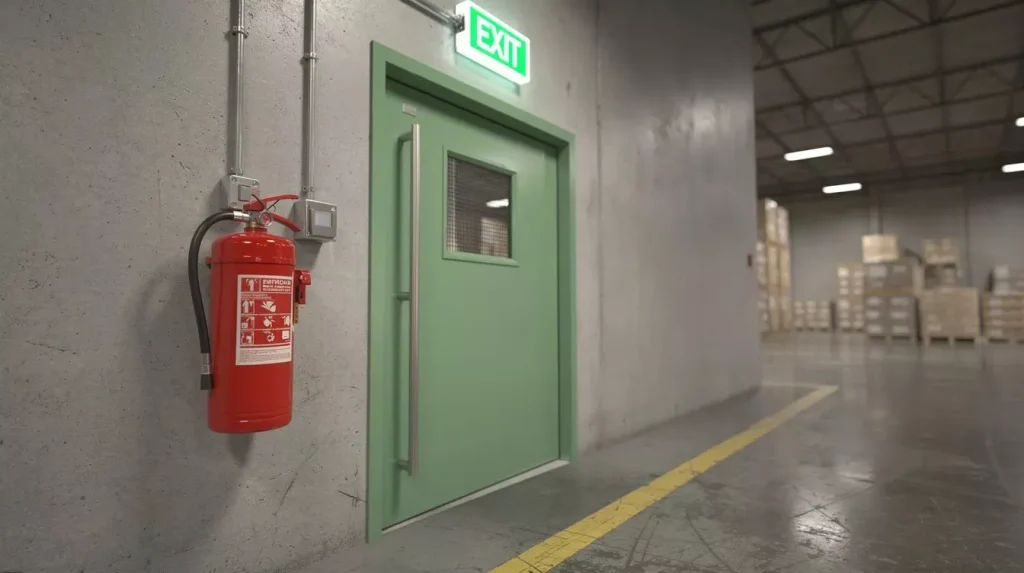
Correct positioning is as important as choosing the right type of fire extinguisher. Fire extinguishers must be near exit routes and specific hazards. A competent technician must commission them on-site when installed.
- Mounting height: The carrying handle should be about 1.0–1.5 metres from the floor. Extinguishers must be easy to reach and properly mounted to avoid obstruction. It’s important to use wall brackets or stands, not loose on the floor.
- Position along evacuation routes: Place extinguishers on escape routes, near final fire exits, and on stair landings. This way, users do not have to go deeper into the building. Never let equipment block escape routes.
- Special risk siting: Place extinguishers close enough to hazards for quick use but far enough to keep users safe when retrieving them.
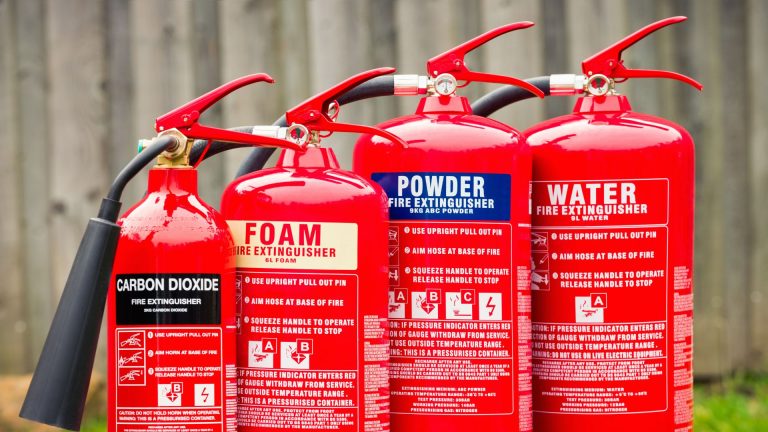
- Colour coding: Under BS EN 3, extinguisher bodies are red with a coloured band—red for water, cream for foam, blue for dry powder, black for CO₂, yellow for wet chemical. Fully coloured bodies usually mean pre-1997 units that should be replaced.
Every extinguisher must have an ID sign showing its use. Clear signage at each fire point helps staff pick the right unit under pressure. Our fire signage guidance explains how to do this consistently.
FireArrest stores photos and serial numbers for each extinguisher. This provides proof of commissioning and location during audits.
7. Inspection, Servicing and Lifecycle Requirements
The Fire Safety Order and BS 5306-3 set out clear inspection and maintenance intervals.
| Visual inspection | Monthly | Responsible person or nominated staff |
| Basic service | Annually | Competent person (BAFE SP101 certified or equivalent) |
| Extended service / overhaul | Every 5 years (water, foam, powder) | Competent engineer |
| Hydraulic pressure test | Every 10 years (CO₂) | Competent engineer |
| Replacement / condemnation | ~20 years or when unserviceable | Competent engineer |
Monthly checks are recommended to confirm extinguishers are present, unobstructed, correctly mounted, undamaged, with intact tamper seals and normal pressure. Annual servicing of fire extinguishers must include weight checks, operability, seal replacement, and issuing service certificates. Water, foam, and powder extinguishers need overhauls every 5 years, while CO₂ extinguishers require testing every 10 years.
Refill or replace any fire extinguisher that’s been discharged, even partially, immediately, and ensure that you’ve kept records of fire risk assessments and maintenance accessible for inspection. FireArrest holds a full digital audit trail, service dates, engineers, test results, photos, and certificates, accessible across all sites.
An important note about PFOA foam
Foams containing PFOA have been banned in the UK since 5 July 2025, along with contaminated equipment. A wider restriction on PFAS in firefighting foam is in progress and a government decision is expected in 2027. In the EU, restrictions on training and testing foams already took effect in April 2026. Practical advice for a buyer in 2026: keep to fluorine-free for confident compliance.
8. Training, Procedures and Ensuring Compliance in Practice
Fire safety equipment alone does not protect property or save lives. Staff must be trained in fire safety and how to use extinguishers in emergencies. The Fire Safety Order and health and safety law require induction training, refreshers, and extra instruction for fire wardens.
Key learning points include knowing fire classes, selecting the right extinguishers, using the PASS technique (Pull, Aim, Squeeze, Sweep), and recognising when not to fight a fire. For example, avoid fighting when smoke fills a corridor, the fire spreads quickly, or evacuation routes are blocked.
Include extinguisher use in regular fire drills and emergency plans. Define clear roles, assembly points, and communication procedures. This reduces risk by ensuring everyone knows what to do and where the nearest fire safety equipment is. It creates a safe environment for everyone involved.
Local fire authorities enforce fire safety regulations. Failure to comply can lead to fines or prosecution. Non-compliance can also void insurance, leaving the business exposed after a loss. Even false alarms should be recorded and investigated as part of ongoing compliance.
FireArrest simplifies compliance with dashboards that keep information easily available and auditable in one place, plus a handy reminder function that can be set to provide timely reminders for regulatory requirements such as inspections and structured fire safety surveys.
9. Digital Fire Extinguisher Management with FireArrest
Managing hundreds of fire extinguishers across multiple sites with manual spreadsheets and paper certificates is risky. Lost records, inconsistent fire risk assessments, and missed service dates are common during inspections.
FireArrest lets you build a cloud-based register of fire extinguishers and other fire safety equipment. It records type, fire classes covered, ratings, serial numbers, and exact locations by floor, zone, and room. The mobile app lets field teams complete fire risk assessments, extinguisher commissioning, and annual service forms on site. They can capture photos, signatures, and time-stamps for each visit. Data syncs when connectivity returns, so working in basements or plant rooms without signal does not mean starting over.
FireArrest also makes compliance easy to remember. By using the reminders, clients can remember annual servicing and extended tests before they become overdue, with exception reports highlighting missing or out-of-service units. Exportable compliance reports are ready for clients, building owners, and Fire & Rescue audits. For passive fire protection and fire stopping contractors, managing extinguishers alongside fire doors, cavity barriers, and fire-stopping records in one platform gives a full view of building fire safety.
Book a FireArrest demo to see how digital documentation and audit trails can reduce your fire extinguisher management risks and improve fire protection projects.
Frequently Asked Questions
Do UK fire extinguisher regulations apply in small offices or shops with only a few staff?
The Fire Safety Order applies to almost all non-domestic premises, regardless of size. Even small offices and retail units must have suitable extinguishers based on a fire risk assessment. The “two Class A extinguishers per floor” rule can be adjusted for very small spaces where multiple units would block escape routes. However, you must justify and document this decision. For compact premises with low fire load, a single properly rated Class A extinguisher plus a CO₂ extinguisher for electrical equipment is often enough, subject to professional advice.
Are dry powder extinguishers still allowed inside buildings in the UK?
Standard ABC dry powder extinguishers are not banned. However, BS 5306-8 advises against their use in many indoor workplaces. This is due to poor visibility, inhalation risk, and clean-up issues after discharge. They remain suitable for some high-risk or outdoor areas such as plant rooms with mixed risks, LPG storage, or vehicle parks. The fire risk assessment should justify their use over foam or CO₂. Always consult a competent fire safety professional before specifying widespread indoor dry powder use.
How often must fire extinguisher training be refreshed?
UK law does not set a fixed refresher interval. However, many Fire & Rescue Services and insurers recommend refresher fire safety training at least every two to three years. High-risk environments may require more frequent updates. Staff should get extra training after major changes in layout, process, or equipment, or after incidents that revealed weaknesses in emergency response. Keeping a digital training log, stored in FireArrest alongside equipment records, shows who has been trained and when refreshers are due.
What evidence do I need to show my extinguishers comply with UK safety regulations?
You need a current fire risk assessment covering extinguisher provision, up-to-date service labels on each unit, annual service certificates from a competent person, records of monthly in-house checks, and commissioning certificates for new units. Extinguishers should have BS EN 3 markings, clear fire-class ratings, operating instructions, and no obvious damage or corrosion. Platforms like FireArrest centralise all this evidence, making it easy to produce during Fire & Rescue inspections, insurer surveys, or audits.
Can I use a multi-purpose extinguisher for all fire classes instead of several different types?
Some extinguishers cover multiple fire classes. However, no single portable unit suits all risks, including class F fires and gas fires with live electrical equipment. Using one extinguisher for all can create hazards, such as using powder where visibility matters or agents ineffective on deep-fat fryer fires. A risk-based mix of extinguishers, guided by BS 5306-8 and the site’s fire risk assessment, is the safest and most compliant approach.